
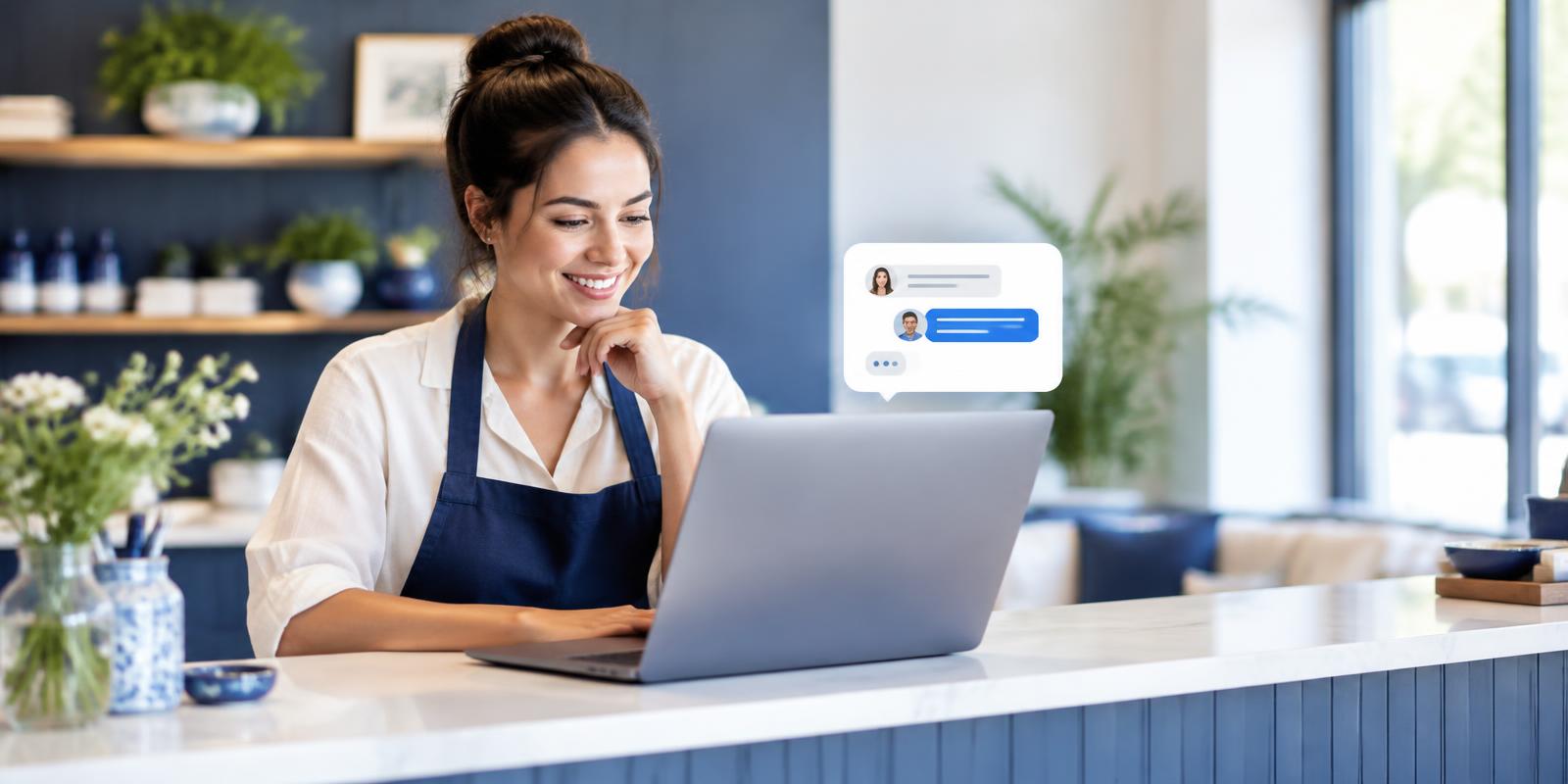
Ads that run beyond staffed hours can still create demand, but visitors may leave if nobody answers their questions. Lumi stays on your website as a text and voice concierge, answering from your approved public knowledge, capturing leads and presenting your booking link. Its first-party analytics record visitor, session, page-view, attribution and booking-start activity. Judge after-hours performance by those signals—not by unsupported claims of confirmed appointments, orders or revenue.
- Lumi answers website questions from approved public knowledge when your staff is unavailable.
- The concierge captures leads and delivers them to staff by email, optional SMS and the Lumi workspace.
- A configured scheduling link gives visitors an immediate next step, while confirmed bookings require a supported calendar connection.
- First-party analytics record visitors, sessions, page views, attribution parameters and booking-start events.
- Lumi does not currently provide ad-spend, CAC, CRM opportunity or verified revenue attribution without the required integrations.
The real nighttime risk is an unanswered visitor, not the hour on the clock
Lumi addresses that gap as an AI Concierge on the business’s website. Customer Lumi provides chat and voice assistance using only information the business has approved for public answers. It can answer a visitor, show relevant offering or product cards, capture a lead and open the business’s scheduling link. That makes the website more useful outside office hours without implying that a staff member is present.
This is part of the broader discipline of helping visitors get reliable business answers. The goal is not to make every late-night click convert. It is to ensure a qualified visitor does not have to wait until 9 a.m. for basic public information or a clear way to express interest.
What Lumi does when an ad-driven visitor arrives after hours
Lumi for your website remains available through the embedded concierge when the human team is not working. Its text chat has been verified in 12 languages. The assistant reads approved public knowledge and the business’s tenant configuration, then records the conversation and messages in the private workspace. It provides no answer from business knowledge until that material has been approved for public use.
The after-hours visitor journey
Public rich cards use only business-owned images from the website, merchant uploads or a connected SHOPLINE catalog; Lumi does not generate images for those cards. That helps the concierge keep the visual presentation tied to the business’s real offerings.
What you can measure before changing your nighttime ad schedule
Lumi receives first-party activity from its conversations and the website widget. Available website signals include visitors, sessions, page views, attribution and booking-start events. The current page URL is captured as a path, together with attribution parameters; other query parameters are stripped. This gives the business evidence about what happens after an ad-driven visitor lands, even when nobody is monitoring the site live.
- Identify sessions and conversations occurring outside staffed hours.
- Review the questions those visitors asked and whether the approved knowledge produced a useful response.
- Check lead captures and booking-start events associated with those visits.
- Read the conversation context so the team can see where visitors continued, hesitated or needed information that was unavailable.
- Improve the public knowledge where legitimate recurring questions are not yet covered, then review future conversations again.
Treat email acknowledgments and concierge answers as different tools. An acknowledgment confirms that a message arrived; Lumi provides an interactive response based on reviewed website knowledge. The distinction is explained further in email acknowledgments versus website answers.
Accurate public knowledge matters more after staff leave
An after-hours concierge is valuable only when its answers are controlled. Lumi restricts Customer Lumi to material approved for public use; private and internal business knowledge belongs in the private workspace rather than in visitor answers. This boundary is especially important when nobody is present to notice an outdated promotion, telephone number or service claim in real time.
Before sending paid traffic to a page, review the material Lumi will use. Keep unannounced offers out of public sources by following a process for excluding draft retail promotions from answers. Where visitors depend on telephone details across languages, test approved phone numbers in multilingual responses rather than assuming every version is correct.
Knowledge also needs maintenance after the initial setup. A website redesign, content rewrite or reimport can change the source material behind an answer. Recheck business answers after website reimports so the concierge reflects the information the business currently intends to publish.
Lead follow-up still belongs to your team
Lumi reduces the cost of delayed response, but it does not remove the need for human follow-up. Leads currently reach staff through email, optional SMS and the Lumi workspace. No CRM provider is implemented: there is no HubSpot, Salesforce, Pipedrive or Zoho connection, and no CRM contact sync, activity sync, bidirectional sync, webhook or generic lead export.
That means the next-business-day process matters. Assign ownership for reviewing new leads and conversations, decide which inquiries deserve personal outreach, and use the recorded context before responding. The concierge handles the immediate website interaction; the team handles any conversation requiring judgment, private details or a person’s commitment.
Location-sensitive questions deserve particular care. Lumi knows the content and connected sources available to it; it does not automatically know where a field employee is. Businesses with mobile teams should consider whether website answers know a technician’s location before promising location-aware responses.
Commerce sites get a more direct path from question to cart
When a business connects a SHOPLINE store, Lumi can use synchronized SHOPLINE catalog data to answer product questions. Visitors can filter by minimum price, maximum price and in-stock status. On the SHOPLINE storefront, Lumi can add products to the real store cart, change quantities and remove items. Each quantity action supports 1–20 items and is checked by reading the cart back.
Cart actions work only through the SHOPLINE App Embed on the SHOPLINE storefront; they are unavailable on non-SHOPLINE websites. Lumi does not calculate discounts, tax, shipping or totals. Any discount value shown comes directly from SHOPLINE’s cart response. Checkout is redirected to the store’s cart URL, while payment and order creation remain entirely with SHOPLINE.
This gives an after-hours shopper a productive path from a product question to the merchant’s own cart. It does not prove that the shopper completed payment. Lumi does not receive SHOPLINE orders or hold the shopper’s SHOPLINE identity, and its experimental checkout reference has not been confirmed as order or revenue attribution.
How to decide whether to keep ads running outside office hours
Choose based on observed visitor behavior
The right decision comes from the full path: ad click, page visit, concierge interaction, lead or booking start, and human follow-up. Do not shut off nighttime advertising simply because the office is closed. First remove the avoidable response gap and inspect what those visitors actually do.
Lumi is part of the OceSha ecosystem and is powered by OceSha. OceSha Ventures builds and operates AI-first solutions, including AI assistants, course creation, branded academies and business intelligence. Lumi itself is a product rather than a separate legal entity and is sold by OceSha Inc.
To assess your after-hours visitor journey and the knowledge needed to support it, contact the Lumi team. Bring the questions your sales or service staff hear most often, the pages used by your ads and the next action you want a qualified visitor to take.
Lumi, the AI Concierge for your website, gives ad-driven visitors useful answers, captures their details and directs them toward the next step when your team is unavailable.
Close the after-hours response gapFrequently asked questions
Does Lumi replace an after-hours employee?
No. Lumi handles public website questions, lead capture and configured next steps using approved information. Staff remain responsible for follow-up, private matters, judgment calls and business commitments.
Will Lumi answer before our knowledge is approved?
No. Customer Lumi provides answers only after the relevant public knowledge has been approved. Private and internal material remains separate from public visitor responses.
Can Lumi tell us which nighttime leads became customers?
Not through a current CRM connection. No CRM provider is implemented, and opportunity, customer and revenue metrics require a CRM or pipeline integration. Leads are available by email, optional SMS and in the workspace.
Does opening the booking link mean an appointment was made?
No. Opening the link records a booking-start event. Lumi knows that a booking was confirmed only where a supported calendar source is connected; current confirmation support depends on the configured Calendly or Google Calendar connection.
Can Lumi calculate return on ad spend?
No. Current first-party analytics include visitor, session, page-view, attribution and booking-start activity, but ad spend and CAC are unavailable without the required ads integration. Current data should not be used as verified revenue attribution.
Can a connected SHOPLINE store sell through Lumi after hours?
Lumi can answer from connected SHOPLINE catalog data and manage the real storefront cart through the App Embed. SHOPLINE performs checkout, payment and order creation. Lumi does not receive order confirmation and cannot verify that a cart interaction produced revenue.
The bottom line
Do not assume every nighttime click is wasted simply because your team works 9–5. The stronger move is to make the landing experience useful after hours, then evaluate real visitor behavior. Lumi answers from approved public knowledge, captures leads, supplies a booking path and records first-party engagement signals. It does not turn booking starts into confirmed appointments or infer revenue from incomplete data. Use the concierge to close the immediate response gap, give staff the conversation context for follow-up, and change ad hours only when the resulting evidence supports that decision.

Rohan Hall
Founder of OceSha Ventures · AI architect and author
Rohan Hall is a technology entrepreneur, AI architect and author with years of technology experience, now focused on practical AI across business, education, government and global impact. He founded OceSha Ventures, builds the OceSha AI platform and Lumi, and wrote The Convergence of AI and the Top 10 Emerging Technologies.
OceSha Ventures — OceSha Ventures builds and operates AI-first solutions — course creation, branded academies, AI assistants such as Lumi, and business intelligence — for businesses and organizations.
Sources
About this page
It is based on Lumi's current approved product information. Product details come from Lumi's current product capabilities audit (Oct 2026).